

Every summer, thousands of people make the familiar trip from Queanbeyan and Canberra to the South Coast. If you have ever found yourself inching through traffic or wishing the journey felt more like part of the holiday, there is another way.
Long before this became a coastal getaway route, these backroads carried miners, gold escorts, supplies and cash moving between the goldfields of Majors Creek and Araluen and the administrative centre of Braidwood. The wealth flowing along these roads reshaped the region and, in turn, attracted some of the most notorious bushrangers in New South Wales. Tracing this route today transforms a routine drive into a relaxed day of discoveries, connecting you directly to Australia’s gold rush era.
Majors Creek
Approx. 60 minutes from Queanbeyan
Majors Creek was once one of the most productive goldfields in New South Wales. During the gold rush, it drew an estimated 2,000 hopeful miners and at its peak, the miners averaged an ounce of gold per person per day!
Today, only a few hundred residents remain, but the physical traces of the gold rush are still visible in the landscape. Walking the village and nearby creek lines reveals some signs like eroded creek beds and prospecting pits. If you have a Fossicking License, you can gold pan in creek beds with public access.
In November, it’s worth planning your travels around the Majors Creek Festival. Every year, this three-day folk and roots music festival showcases an incredible program of bush dances, live performances, classes and workshops, and more. There’s typically a full kids’ program as well as food and drink stalls.
For lunch, Majors Creek Hotel serves up classic and delicious pub fare, which you can enjoy on the nostalgic wraparound verandah. Originally named The Elrington Hotel, the building is a great reminder of the town’s prosperous past. There are also many old photos on the walls that document what life was like during the rush.
Just outside of town is Clarke’s Lookout with great views over the Araluen Valley. Regale the kids with stories of how the lookout was used regularly by the Clarke brothers (more about them to come) to spot coaches and travellers to and from Braidwood.
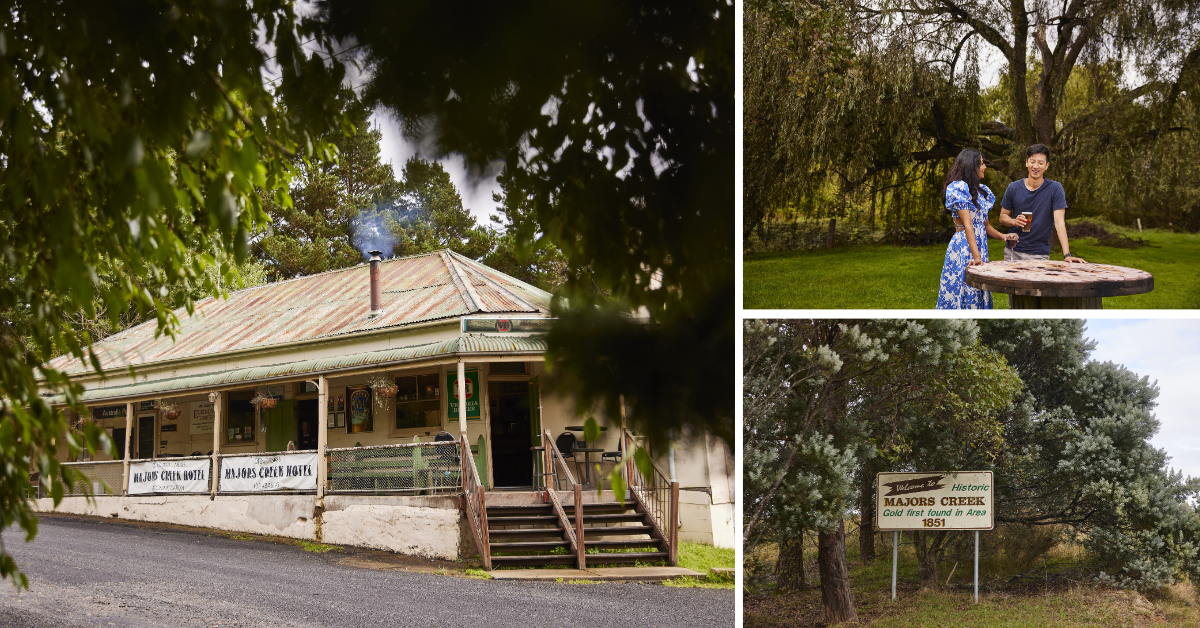
Approx. 25 minutes from Majors Creek
Bushranger or gold rush enthusiasts will love the historic town of Araluen. The narrow, winding approaches to the valley were notorious for bushranger ambushes. At its peak around 1852, Araluen produced 2839 kilograms of gold and was home to 26 hotels and 4,000 people.
Today, you can directly engage with this history by panning for gold at Araluen Creek campground. An interpretive storyboard introduces the valley’s mining past and marks the starting point of the Araluen History Trail, a trail linking ten key sites as a way to conserve and record what life was like in the valley. Note that the campground has upgraded facilities including toilets, picnic tables, BBQs and water tanks, making it an easy and comfortable stop.
Stops #2 and #3 on the Araluen History Trail lead to the Church of England and Roman Catholic cemeteries, where many graves date from the gold rush period. Among them is the grave of Alexander Waddell, one of the co-discoverers of gold in the area, who was buried in Araluen in 1898 after a long career in gold mining.
At stop #5, the Araluen Federal Hall, children may be particularly interested in the storyboard in the garden, which depicts what schooling was like for families living in the valley during the 1850s.

Approx. 25 minutes from Araluen
This town likely needs no introduction but chances are you’ve only stopped to shop and lunch, barely scratching the surface of the town’s role during the gold rush. In the 1850s, major gold discoveries in nearby Araluen and Majors Creek turned Braidwood into a critical service and administrative hub. Gold wealth funded many of the substantial buildings that still define the town today.
It was this movement of gold and money that drew the attention of bushrangers, most notably the Clarke brothers. These Irish-born brothers carried out frequent and organised armed robberies and were repeatedly brought before the Braidwood Court. While the original courthouse, built in 1837 no longer stands, it was replaced on the same site in 1900 by the current Braidwood Courthouse, which now serves as police premises.
More colour on the Clarke brothers, along with broader accounts of the region’s Indigenous, colonial, multicultural and 20th-century history, is preserved in detail at the Braidwood Museum. The museum also features an exhibition exploring the experiences of Chinese gold rush immigrants, as well as a significant 1850s gold bullion transport safe, a rare cast iron box once used to secure gold from the Araluen goldfields.
The museum is open Friday and Saturday from 11am to 2pm. Guided walking tours of the town are also available for those wanting deeper insight into Braidwood’s layered past.

And of course, you can always follow this route in reverse on your way home from the coast, stretching that holiday feeling a little longer.
Written by Thuc Do for Visit Queanbeyan-Palerang.